Amaravati land pooling: how the scheme works, and the second round under way in 2026
The government did not buy this land. It asked farmers to hand it over and take back developed plots and a yearly payment instead. In 2015 farmers agreed to give more than 34,000 acres, and 33,008 acres were pooled within six months. CRDA's own report called it the fastest land procurement on record. A second round began on 7 January 2026 in seven more villages.
Last reviewed
- 33,008 ac
- Pooled in 6 months (2015)
- 26,512
- Farmers in that first sweep
- 75.07%
- Pedamadduru pooling (Sep 2026)
- 16,666 ac
- Phase 2 notified (7 villages)
In this section
How land pooling works, in plain words
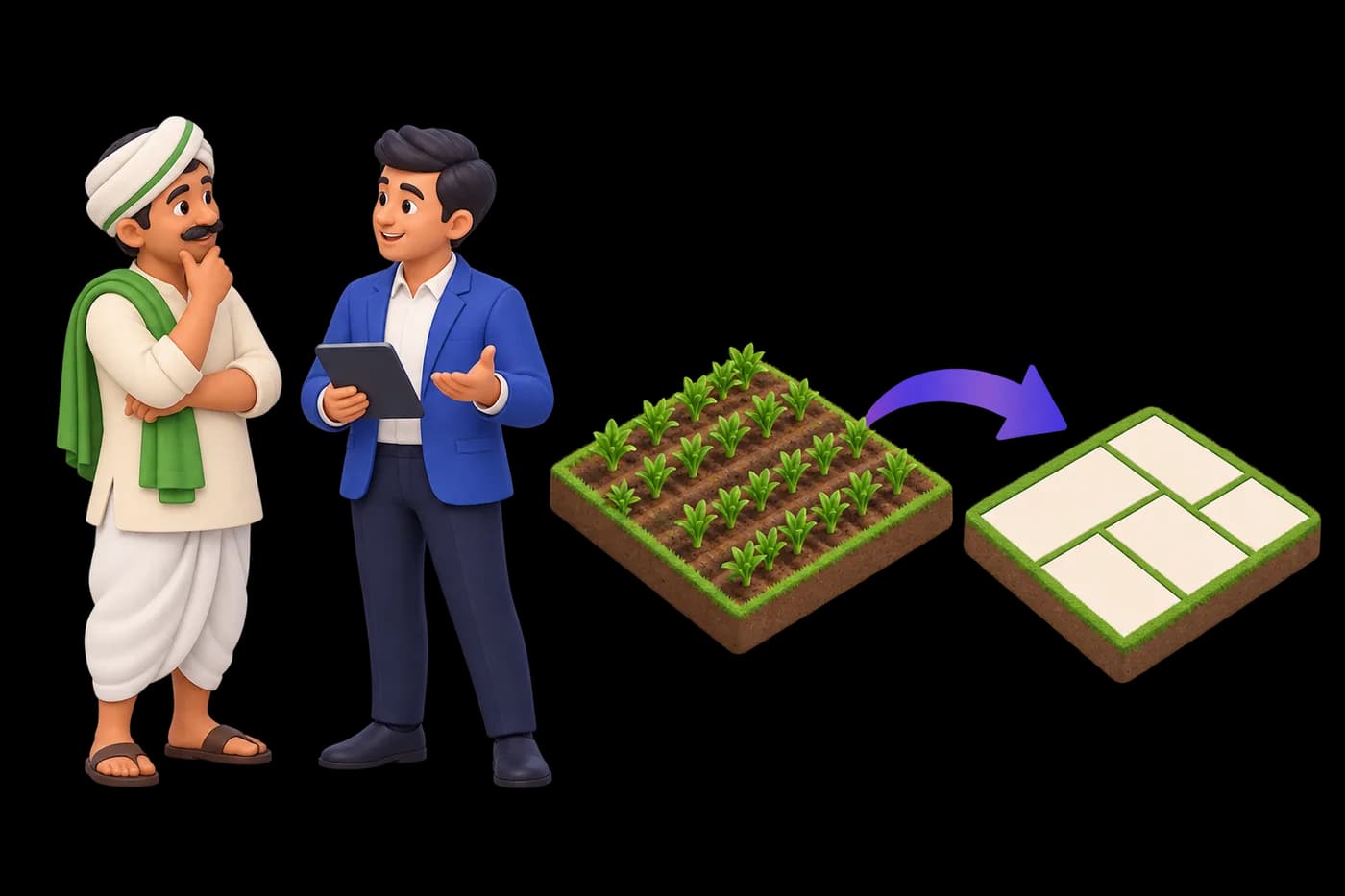
A farmer signs an agreement and hands the land to CRDA. For each acre of ordinary dry patta land, the farmer is owed 1,000 square yards of residential plot and 250 square yards of commercial plot. If the land is officially accepted as jareebu, the commercial share goes up to 450 square yards. How many plots that becomes, and where they are, depends on the approved layout and the draw.
Those plots take years to be ready. Until then the farmer is paid every year for each acre given, and the amount goes up a little each year. The payment runs for ten years. Phase 1 farmers get fifteen, because the government added five more years in 2024. Families who owned no land but earned their living from it get a monthly pension.
The rest of the acre does not come back. It becomes roads, drains, water lines, parks and public land. Some of it is land the authority sells or allots to pay for building the city. That is the trade. A farmer gives a field and gets back a smaller piece of a city, with roads and services.
Two rounds, under two sets of rules
| Phase 1 | Phase 2 | |
|---|---|---|
| Rules | Capital City Land Pooling Scheme Rules, 2015 | Capital Region Land Pooling Scheme Rules, 2025 (announced 4 July 2025) |
| Villages | 24 villages, 29 habitations in Thullur, Mangalagiri and Tadepalli mandals | 7 villages: Vykuntapuram, Pedamadduru, Endrayi, Karlapudi-Lemalle (Palnadu) and Vaddamanu, Harischandrapuram, Pedaparimi (Guntur) |
| Land | Target 38,581 ac; consent 34,690 ac; 33,008 ac pooled within six months | 16,666.57 ac patta and assigned; 20,494 ac including 3,828 ac government land |
| Started | January 2015 | 7 January 2026 at Vaddamanu |
| Purpose | The 217 sq km capital city | Sports City, railway line and station, Inner Ring Road, seed axis road, institutions; airport in a later phase |
Where things stand, with dates
- Phase 1 farmers are still getting their plots in batches, through e-lottery draws. 496 plots went out on 23 January 2026, 76 on 18 July, 113 on 14 August and smaller batches in September. Roads, drains and water lines inside the layouts are being built street by street, and in September 2026 the Cabinet raised the money for layout works to ₹1,548.98 crore.
- At its meeting on 7 July 2026, CRDA approved four things: ₹40,000 towards rent for farmers who pooled from 12 June 2024 onwards, ₹10,000 a year for the loss of the village common land, a loan waiver for families in the newly pooling villages, and an international school in each of the 25 townships.
- Phase 2 pooling went on past its first target date of 28 February 2026. The latest dated village figure is from Pedamadduru: 764.23 of its 1,018 acres, or 75.07%, in a report of 18 September 2026. The minister said he expects 80% of the land to be in by the end of October. The current land pooling status page keeps these figures with their dates.
- A new round has started outside Phase 2. The Cabinet approved pooling of 2,344 acres in Mothadaka in August 2026 and APCRDA notified it the same month. In September the Cabinet approved another 6,212.50 acres in Kantheru and Tadikonda mandal, for the railway line and the Inner Ring Road. We track each village on our new pooling round page.
Questions people ask
Is land pooling the same as the government taking my land?
No, and the difference matters. When land is acquired, the government pays cash under the 2013 law and the land is gone for good. Pooling is something you agree to. You give the land, and you get back developed plots, a yearly payment and other benefits. Amaravati was built mostly on pooling. Acquisition was used only for people who refused and for a few specific projects.
Was Pedaparimi part of Phase 1?
No. Pedaparimi stayed a revenue village of Thullur mandal outside the 2015 capital city notification. It is one of the seven Phase 2 villages, with 5,886.18 acres of patta land notified in November 2025.
How many farmers gave their land?
CRDA's own status report counted 26,839 farmers by late 2017. In the first six months of 2015 alone, 33,008 acres came from 26,512 farmers. Land Conflict Watch, which tracks these things independently, counts 21,374 households affected.
Want a straight answer about a plot or a village?
We live and work in the capital villages. Send the survey number or LP number and we will tell you what we know, including the things that should make you pause.