FSI, Coverage, Setbacks and TDR Explained
Plot area, FSI, coverage and setbacks each limit a building in a different way. This page explains each term in plain words. Then it shows how the ebook’s TDR example changes with the land value where the rights are used.
Last reviewed
Explore your numbers
Explore the ebook’s TDR example
Historical teaching example only: the ebook uses a 1:2 credit and an origin-to-receiving value adjustment. These inputs are hypothetical rates, not current land prices or confirmed TDR values.
- Example credit (2×)
- 100 sq yd
- Example value
- ₹1,00,000
- Receiving floor-area equivalent
- 50 sq yd
Current certificate terms, receiving-site rules and authority approval must confirm usable additional floor area. The building calculator does not add this result.
Calculations run on this device. No personal details are needed. Values are rounded for display only.
Five terms to keep separate
| Term | Simple meaning |
|---|---|
| Plot area | The land inside the plot boundaries. |
| FSI | Floor Space Index: counted total floor area divided by plot area. |
| Coverage | The part of the plot covered by the building footprint. |
| Setback | The open distance required between a boundary and the building. |
| TDR | Transferable Development Rights: a certificate-based right that may be used under specified rules. |
FSI does not mean number of floors
A 300 sq yd plot has 2,700 sq ft of land. With FSI 2.00, its FSI-only total is 5,400 sq ft.
That total could be distributed across floors in different ways. Coverage, setbacks, height and other rules constrain the design.
G+3 is a storey limit in the table. It does not mean four floors may each cover the whole plot.
Coverage and setbacks can reduce the usable footprint
For the same plot, 70% coverage gives a footprint ceiling of 1,890 sq ft.
The rectangle left after setbacks might be smaller. If it is smaller, use that rectangle in the simple screen.
Stairs, parking access, light, ventilation and services can require a different real design. The geometric screen is only a starting point.
What the booklet says about TDR
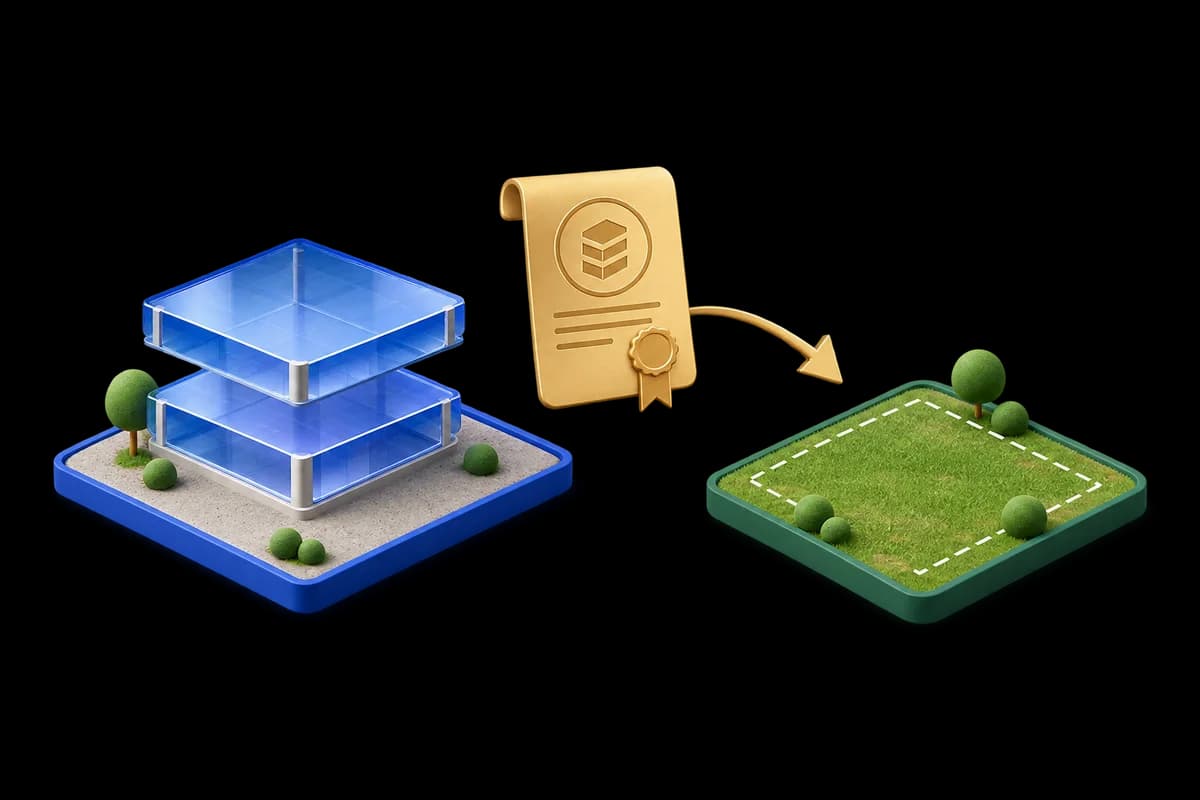
The ebook discusses TDR as an option for leftover returnable-plot entitlement. It gives a 1:2 floor-space credit example.
Its later example also adjusts for the values at the origin and receiving locations. A 1:2 credit does not always mean twice the leftover area can be built elsewhere.
TDR is not a new physical plot. It is not cash in a bank account. Its use or sale depends on the certificate and applicable rules.
The historical 50 sq yd example
These are the booklet’s teaching values, not current market quotes. Use the interactive example to understand the ratio.
Do not add the result to a construction plan without checking the current certificate rules and the receiving plot’s limits.
| Step | Example calculation |
|---|---|
| Leftover returnable entitlement | 50 sq yd |
| Example credit at 1:2 | 50 × 2 = 100 sq yd |
| Illustrative origin rate | ₹1,000 per sq yd |
| Illustrative credit value | 100 × ₹1,000 = ₹1,00,000 |
| Receiving site at ₹2,000 per sq yd | ₹1,00,000 ÷ ₹2,000 = 50 sq yd floor-area equivalent |
| Receiving site at ₹10,000 per sq yd | ₹1,00,000 ÷ ₹10,000 = 10 sq yd floor-area equivalent |
| Receiving site at ₹500 per sq yd | ₹1,00,000 ÷ ₹500 = 200 sq yd floor-area equivalent |
Checks before using or buying a TDR certificate
Our building-area calculator excludes TDR. This avoids combining a historical example with an unverified current building entitlement.
- Confirm the issuing authority and certificate reference.
- Check the holder, extent and type of development right.
- Confirm whether any rights have already been used or transferred.
- Confirm the valuation method and applicable units.
- Check whether the receiving zone and plot can accept the rights.
- Ask the designer to include the rights in the approval calculation.
Want a straight answer about a plot or a village?
We live and work in the capital villages. Send the survey number or LP number and we will tell you what we know, including the things that should make you pause.